

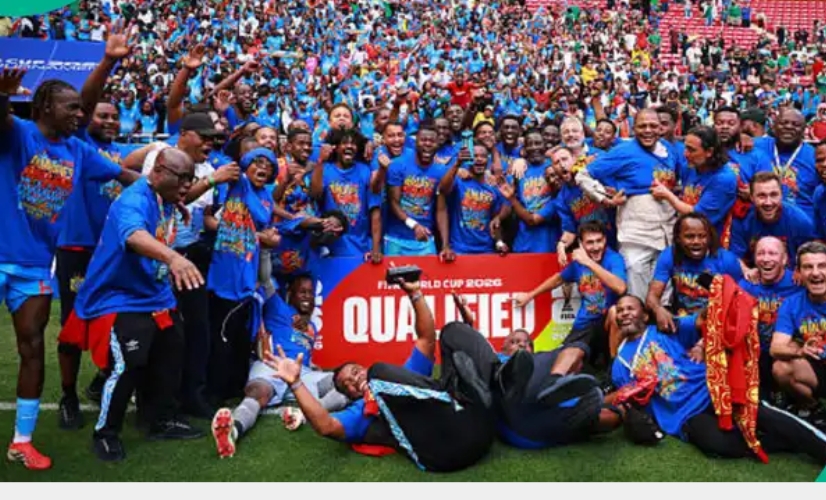
There is a particular kind of heartbreak that comes from being told you are not welcome at a party you helped make possible. That is the feeling spreading across much of Africa today, as fans from the Democratic Republic of Congo, Uganda, South Sudan and their neighbours watch the doors of the 2026 World Cup quietly swing shut in their faces.
The Leopards of Congo have returned to the global stage for the first time since 1974, a triumph generations waited for, and yet the very people who should be filling the stands may be left at home, holding tickets they can no longer use.
The official reason is Ebola.
A genuine outbreak of the rare Bundibugyo strain has indeed struck parts of the region, and the World Health Organization declared a public health emergency in May. No honest commentator should pretend the disease is imaginary or that the lives lost do not matter. They matter enormously. But the question that deserves an honest answer is not whether Ebola exists.
It is whether a 30 day blanket entry ban on entire nations, imposed weeks before the tournament and after fans had already paid, is really about health, or whether health has become a convenient gate through which only some are allowed to pass.
Consider the geography that the bans ignore. Congo is a country the size of Western Europe, and the outbreak is concentrated in remote eastern districts far from the cities most fans would travel through. To treat every Ugandan, every Congolese, every South Sudanese as a walking risk because of an outbreak hundreds of kilometres from their homes is not science. It is shorthand. It is the old habit of looking at Africa and seeing a single undifferentiated place, dangerous by default, guilty until cleared.
What stings most is the timing and the money. Fans applied, paid visa fees, and bought tickets priced under FIFA’s dynamic system at up to seven times the cost of Qatar 2022. They budgeted, borrowed and saved. Then, only after the payments had been collected, came the wall. The Congolese football federation has had to go cap in hand to FIFA simply to ask for refunds, and FIFA’s answer so far has been that it will look into the matter in due course. That is not the language of a body that sees African fans as equal stakeholders. It is the language of an institution that has already moved on.
There is a fairer path, and it is not a secret. Screening works. Modern airports can test and clear travellers at the point of departure, and host nations have the resources to run sanitary filters on arrival. Mexico has chosen exactly this route, opting for surveillance and screening rather than a blanket ban. If one host can protect public health without locking out an entire continent, the others can too. The technology to detect and contain exists. What appears to be missing is the will to treat African supporters as worth the effort.
This matters far beyond football. The World Cup sells itself as a festival of human unity, a rare moment when the whole world gathers under one banner. But unity that applies only to those deemed clean enough, rich enough or safe enough is not unity at all. It is a hierarchy with better marketing. Every African child who watched the Leopards qualify and dreamed of being in that stadium is learning a quiet lesson about where they stand in the global order, and it is not a lesson anyone should be proud to teach.
Africa has a history of containing what frightens the rest of the world. Uganda has faced down Ebola more than once and won. Congo has fought the disease repeatedly and knows its patterns better than any laboratory abroad. To now be lectured about danger by institutions that have never had to build a treatment ward in a rural district is its own kind of insult. The continent does not need pity. It needs partners willing to distinguish between a real outbreak and a sweeping prejudice dressed as caution.
So the call here is not for silence or polite patience. It is for African football federations, for CAF, and for governments across the region to demand answers and to demand alternatives. Push for departure screening. Push for refunds where entry is impossible. Push for the principle that public health and African dignity are not opposing goals. If we accept this quietly, the precedent will harden, and the next excuse for the next tournament will arrive on schedule, aimed once again at the same faces.
The World Cup belongs to the world, and Africa is part of the world whether or not it is convenient to remember that. The Leopards earned their place on the pitch. Their fans earned their place in the stands.
Until the gates open as widely for Kinshasa and Kampala as they do for everyone else, the tournament’s grand talk of bringing humanity together will ring a little hollow, and Africa will be right to keep making noise until someone with the power to fix it finally listens.